Properties5
| Type | Article |
| Author | Srija Mukhopadhyay, Abhishek Rajgaria, Prerana Khatiwada, Vivek Gupta, Dan Roth |
| Date | Aug 30, 2024 |
| URL | https://readwise.io/reader/document_raw_content/323205078 |
| Note created | Aug 30, 2024 |
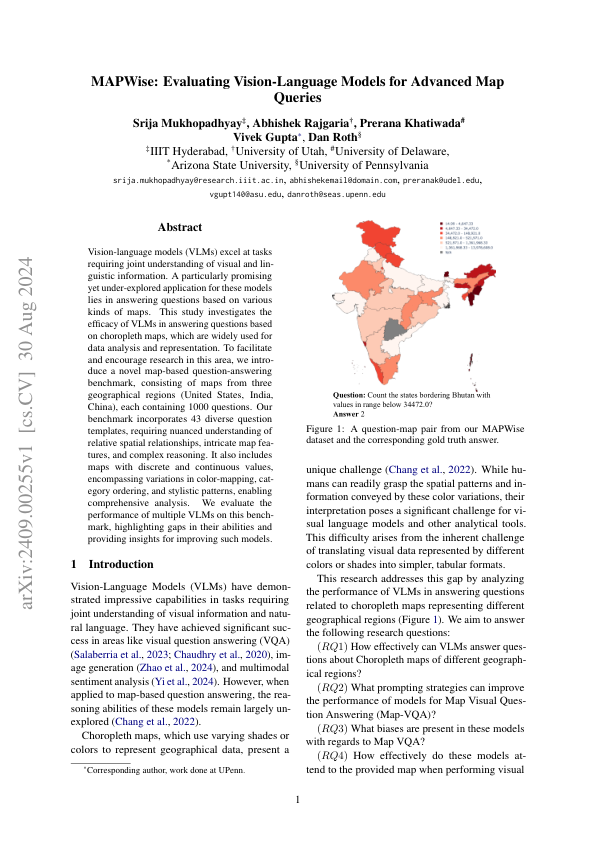
The dataset consists of maps representing data in two primary forms: discrete, where the legend is divided into distinct groups and continuous, where the legend is distributed over a spectrum. The maps also include variations in the presence or absence of annotations, which pro- vide additional contextual information. Our dataset also includes maps with black-and-white textured patterns or hatches for discrete data, different color- map variations (light, dark, and gradient scales), and varying paper background colors (white and grey). These variations test the models’ capability to handle diverse visual presentations.
Each question could have answers in one of the following formats: Binary (Yes/No), Single Word, Count, List, Range, and Ranking. Examples of these are shown in Table 1. All questions were man- ually created by expert annotators, with the help of provided templates, with 10 questions created for each map. Overall, we created 1000 question- answer pairs for each country.
We evaluated the baseline models under two dis- tinct prompting settings: 1. Zero-Shot Chain-of-Thought Prompting (COT). We leverage the Chain-of-Thought (Wei et al., 2023) prompting, presenting the VLM with a map and a question, prompting it to reason through the steps leading to its final answer. 2. Explicit Extraction and Reasoning (EER). Here, we created a custom prompt that ex- plicitly outlined the reasoning steps the model should follow to answer the specific question. This prompt was broken down into four dis- tinct reasoning steps
For binary yes/no and integer count answers, we implemented an exact match criterion and accu- racy as the evaluation metric. For single-word an- swers, as some questions have multiple applicable responses, we employed the recall metric for better evaluation. For state names, a valid answer could be either a two-digit state code or the full state name. For ranges, we first normalized the ranges to absolute values (e.g. 1k to 1000) and then com- pared them. For discrete maps, only exact match was expected, whereas for continuous maps, we gave a full score of 1 for exact match and a partial score of 0.5 for overlapping responses. For list type answer, we used precision and recall metrics because predicted lists often contained ir- relevant states (false positives) and missed relevant states (false negatives). For rank-type answers, we prompted the model to assign ranks to states based on map values. How- ever, due to the difficulty in accurately distinguish- ing shades, models frequently assigned states to wrong shades, resulting in multiple states sharing the same rank despite differing shades.
Smaller models, like QwenVL, CogAgent, and InternLM, faced challenges in producing answers in the desired for- mat. To address this, we used an “LLM as an Extractor” approach, using Gemini 1.5 Flash to extract answers from their outputs.